

Ventilation simulator
iVent NeoPed
Train neonatal and pediatric ventilation without occupying a bed or risking a patient.
- Three languagesFull interface in English, Portuguese and Spanish
- Every screenRuns on desktop, tablet and smartphone
- Runs in your browser, nothing to installChrome 107+Edge 107+Safari 16+ · macOS, iPhone and iPadFirefox 104+An internet connection is required to load every application.
Ventilating newborns and children is a rare, high-stakes skill that is hard to practise at the bedside. iVent NeoPed puts a neonatal and pediatric ventilator in the browser, driven by a physiology engine: no curve is pre-drawn, so the same pneumothorax looks different in RDS than it does in asthma.
- 13
- clinical scenarios across four age bands, preterm to child
- 9
- ventilation modes, from PC-CMV to HFOV and high-flow
- 76
- clinical events in 8 categories, at 4 levels of severity
Built by physicians.Grounded in science.Reviewed by senior clinicians.
Programmed, supervised and guided by physicians. Driven by computational physiology engines built from peer-reviewed research, and tested by senior healthcare professionals.
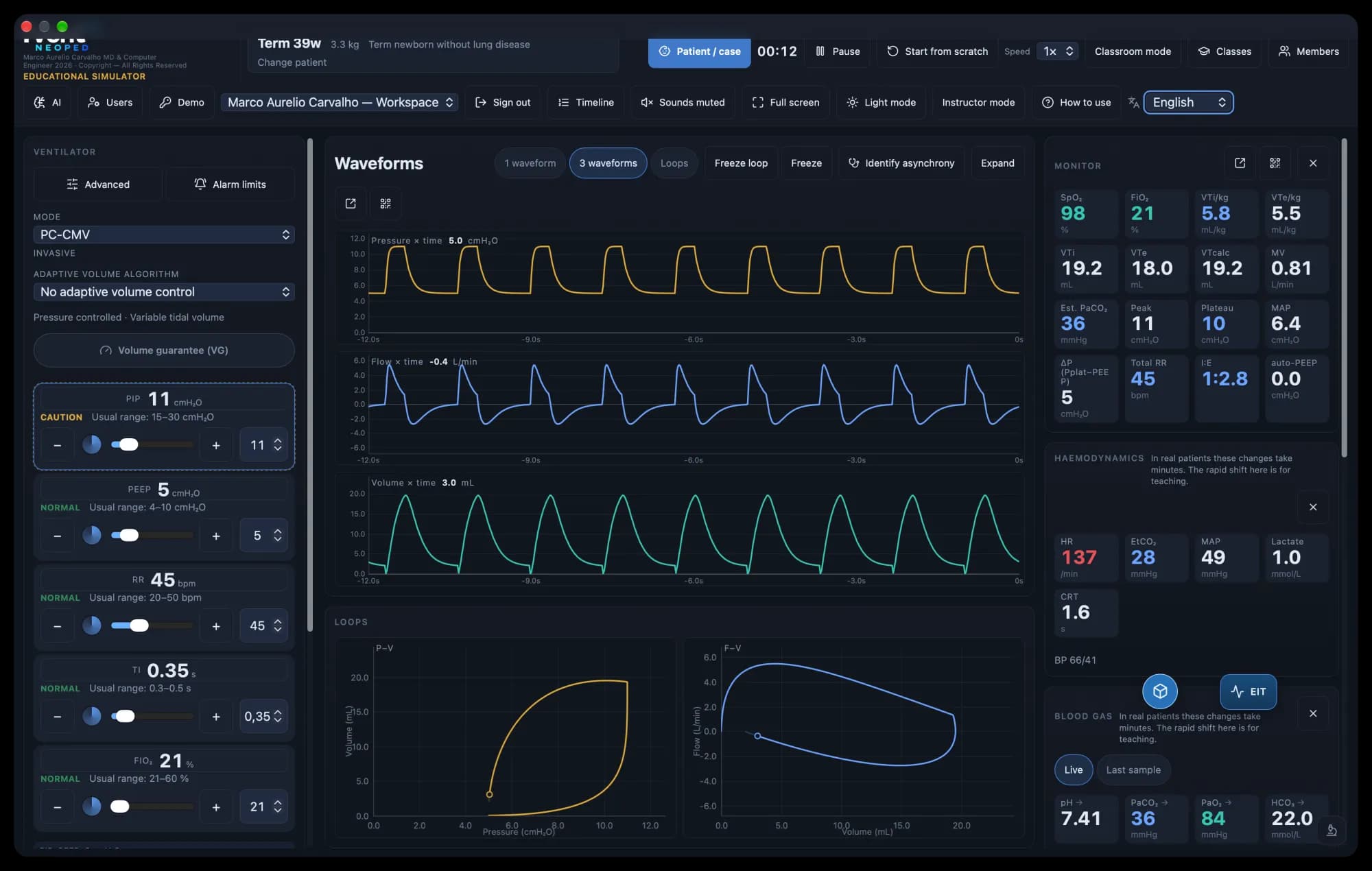
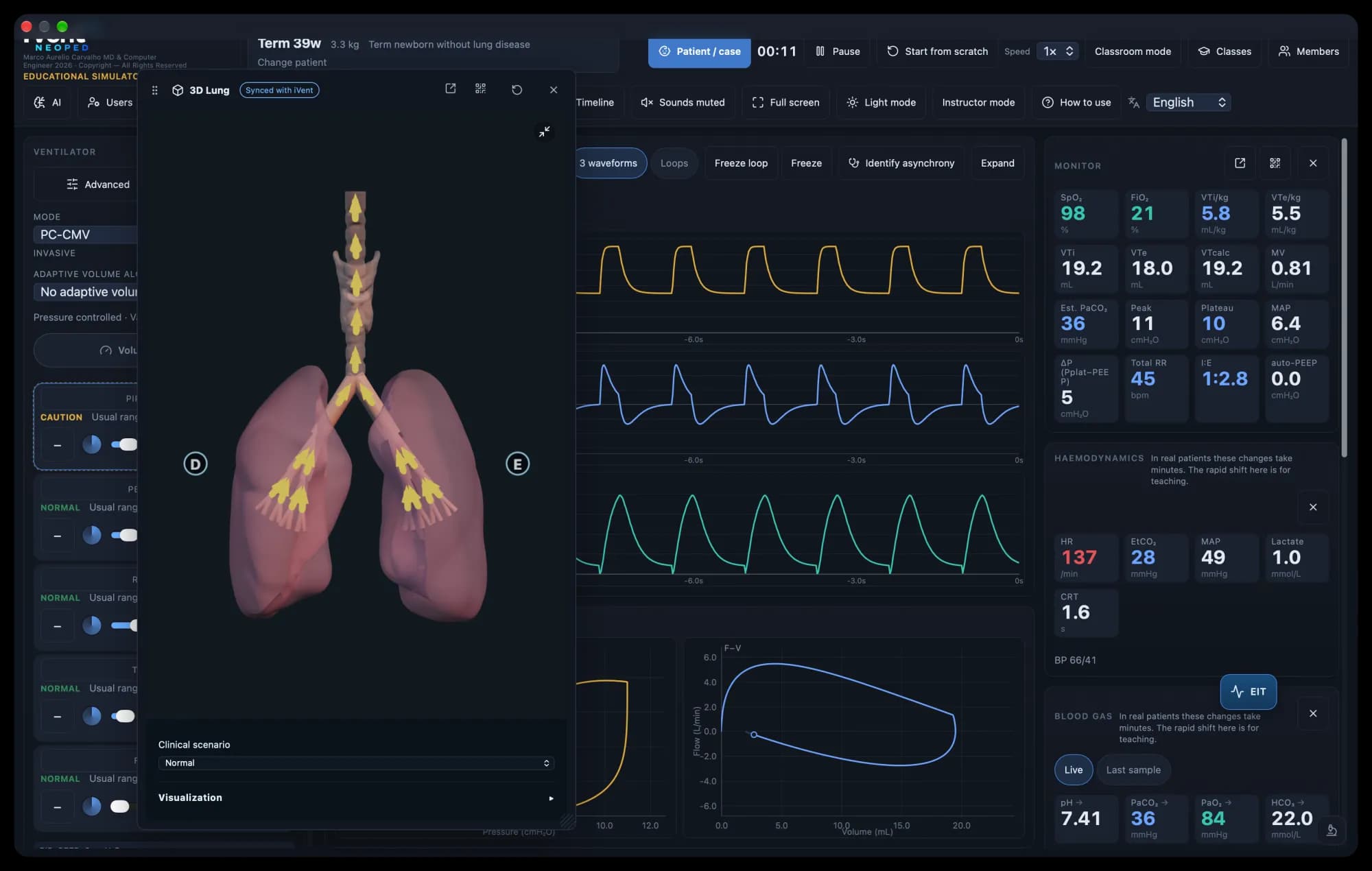
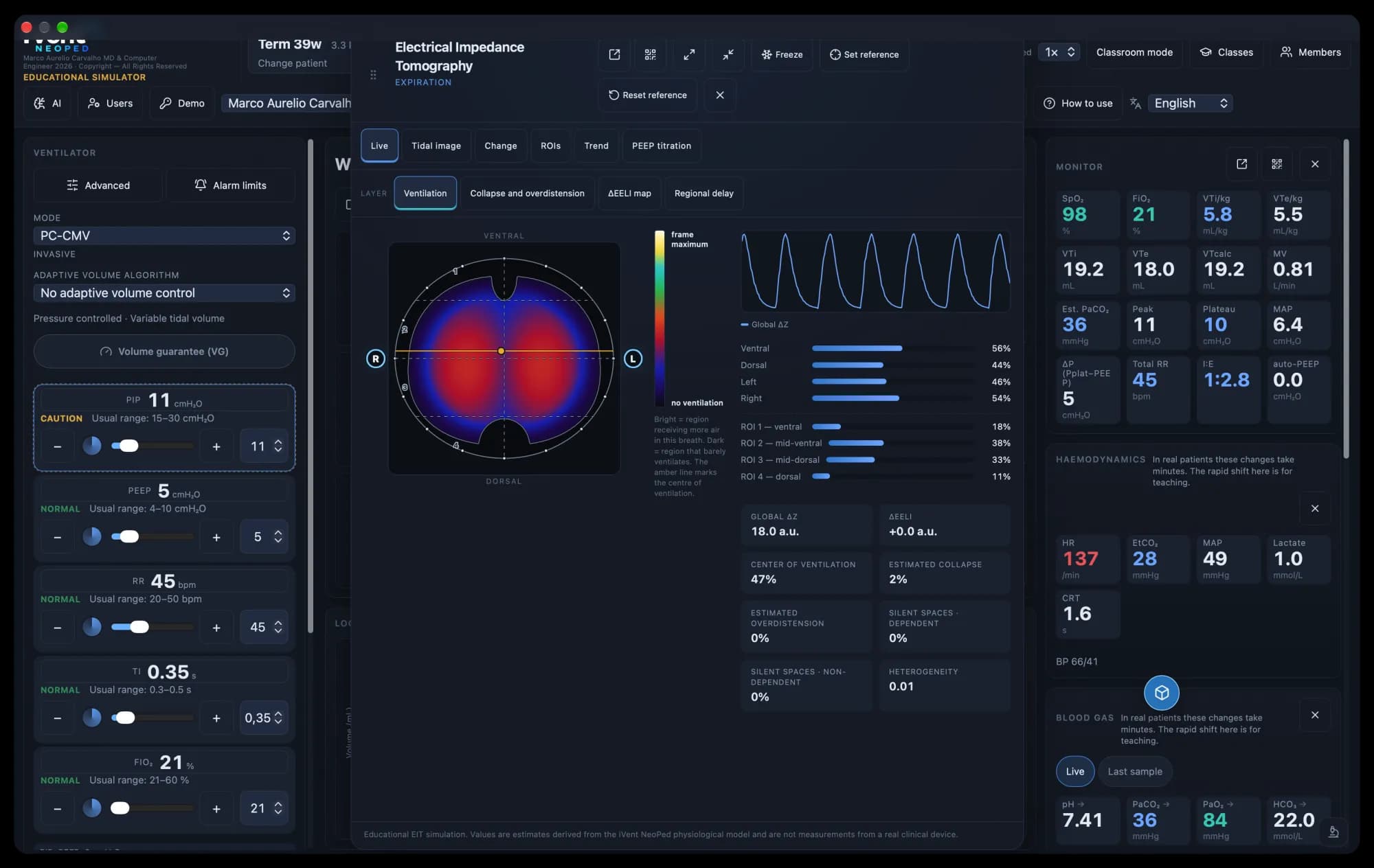
How we build our simulatorsiVent NeoPed on screen
Phone layout 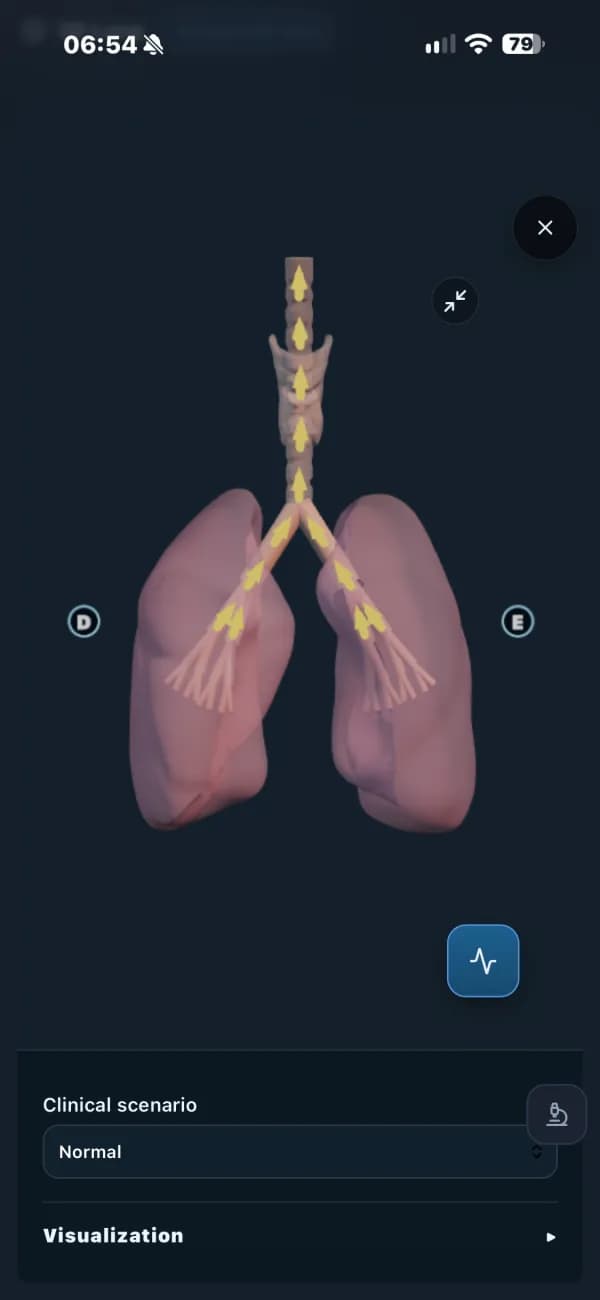
Phone layout 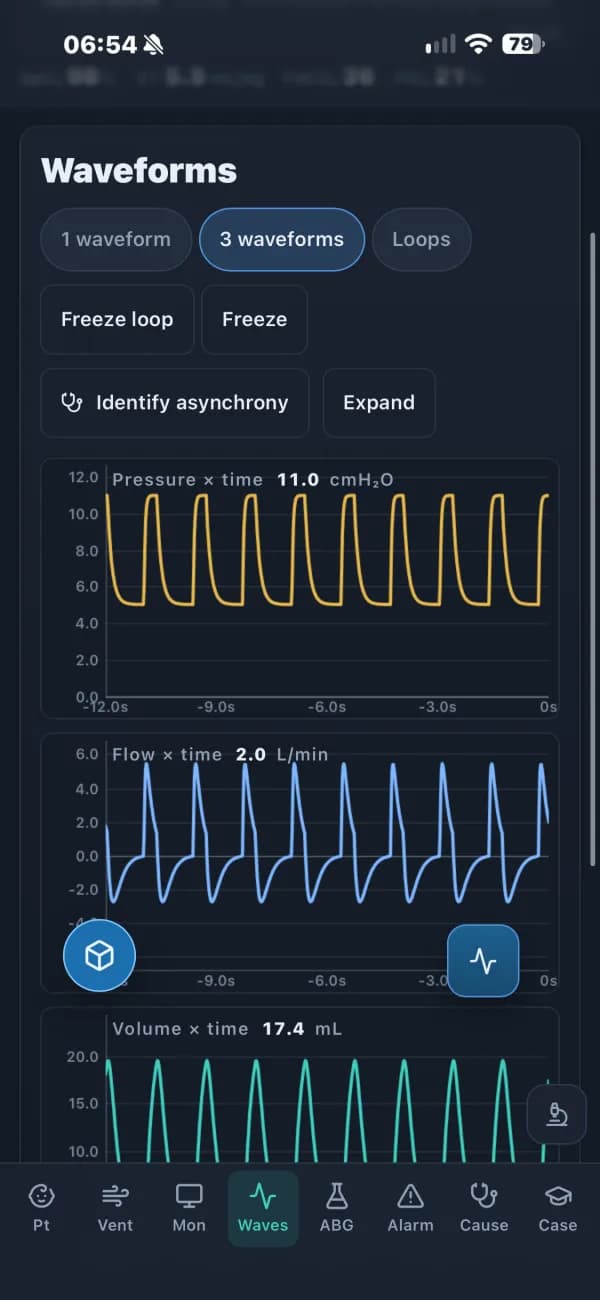
Phone layout
What it does
Everything below is in the app today.
A physiology engine, not an animation
Pressure, flow and volume curves and P–V and F–V loops are calculated from lung mechanics, with a two-compartment model for uneven lungs. The engine is deterministic: the same patient and settings give the same numbers on every screen.
Nine modes with real controls
PC-CMV, PC-SIMV, VC-CMV, PSV, CPAP, NIV, NIPPV, high-flow nasal cannula and high-frequency oscillation. Volume guarantee, rise time, trigger type, tube and leak compensation and apnea backup sit behind basic, advanced and expert interface levels.
Thirteen scenarios you can reshape
RDS, BPD, meconium aspiration, diaphragmatic hernia, PPHN, bronchiolitis, pneumonia, PARDS, asthma, post-op and more, in preterm, term, infant and child patients. A case editor lets instructors change mechanics, gas exchange, drive and fatigue.
Seventy-six events that cascade
Events run at four severities, stack, and evolve with realistic timing: a pneumothorax can progress to tension and obstructive shock. Run them visibly, hidden or at random, including a DOPE challenge for displacement, obstruction, pneumothorax and equipment.
Bedside exam, treatment and blood gas
Eleven bedside exam actions, interventions with a physiological cost, and treatments of the cause: surfactant, bronchodilator and inhaled nitric oxide. Gas exchange and acid–base are modelled, and a blood sample freezes at the moment it was drawn.
Alarms and asynchrony
Sixteen patient-specific alarm limits, teaching alarms for hyperoxemia, volutrauma and auto-PEEP, and an asynchrony lab with ineffective efforts and auto-triggering. A reminder appears when support goes up and the patient doesn’t improve.
3D lung, EIT and hemodynamics
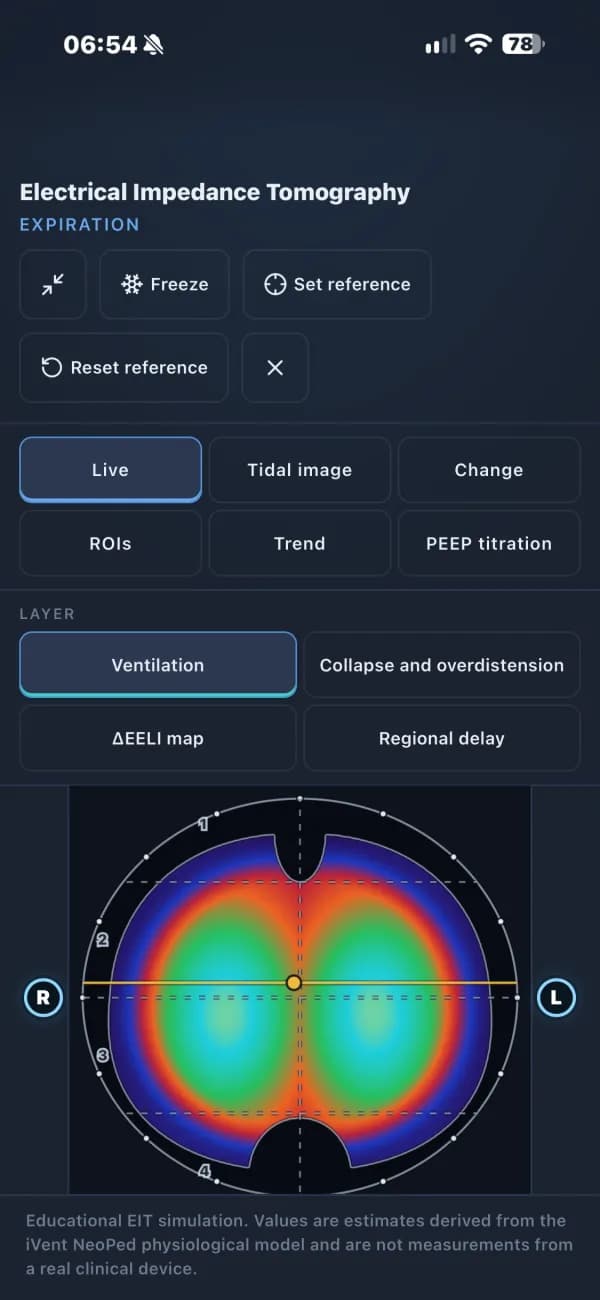
Rotatable 3D lungs and airways that respond to the live physiology, a simulated electrical impedance tomography with six views and four map layers, and an instructor-only hemodynamics module covering cardiac output, oxygen delivery, lactate and heart–lung interaction.
PEEP titration
Step PEEP up or down manually, guided or automatically, with optional constant driving pressure. Each step waits for stability, and the run ends in tables, charts and a report that weighs more than compliance alone.
Built for the person teaching
Hide panels, lock and freeze loops, and annotate a frozen screen with pen, shapes and laser. Open views on a projector or a second monitor, and run the class from your phone as a remote control with 169 commands, or from a USB pedal or Stream Deck.
Debriefing with evidence
After a case, the debrief shows the timeline, the time to diagnosis, and the findings that were available but never checked.
Live class and institutions
Students join from their phones by QR code for polls, multiple choice, true or false, open questions, clinical cases and DOPE drills. Instructors keep question banks, saved lessons and class reports; institutions manage organizations, classes and five roles.
AI analysis, on your terms
An optional analysis explains the current case in the interface language, using the institution’s own API key, stored encrypted. An MCP server gives AI assistants read-only access to the live simulation.
A traceable scientific base
The model is documented in a scientific dossier whose 72 references were checked against their DOI and PMID, and the engine is covered by nearly 1,000 automated tests.
A ventilation class with iVent NeoPed
Ready-made teaching stations run 10 to 20 minutes. A typical session goes like this.
- 1
Choose the patient
Pick a scenario and age band, then set weight and severity, or open a case you saved earlier.
- 2
Set the ventilator
Learners choose a mode and settings and watch the curves, loops and blood gas respond.
- 3
Trigger an event
Drop in a pneumothorax, a blocked tube or an asynchrony, visibly or hidden, from the screen or your phone.
- 4
Examine and treat
Learners examine at the bedside, adjust support and treat the cause, while the engine shows the result.
- 5
Ask the room
Send a poll, a question or a DOPE drill to every phone and see the answers come in.
- 6
Debrief
Walk through the timeline, the time to diagnosis and the findings nobody checked.
Who it’s for and where it runs
Built for
- Neonatal and pediatric residents
- Physicians, respiratory therapists and physiotherapists
- NICU and PICU nursing teams
- Residency programs, universities and simulation centers
Runs on
- Runs in the browser; no hardware to buy
- Desktop, tablet and phone layouts with identical numbers
- Installs as an app; it needs an internet connection to load, then the simulator keeps working offline
- Light and dark themes; English, Portuguese and Spanish
See iVent NeoPed with your team.
Email us and we’ll arrange a walkthrough for your program, department or institution.